The scoop, the salt, and a very small contamination incident. A follow-up to Peanut Butter vs. Nut Effect.
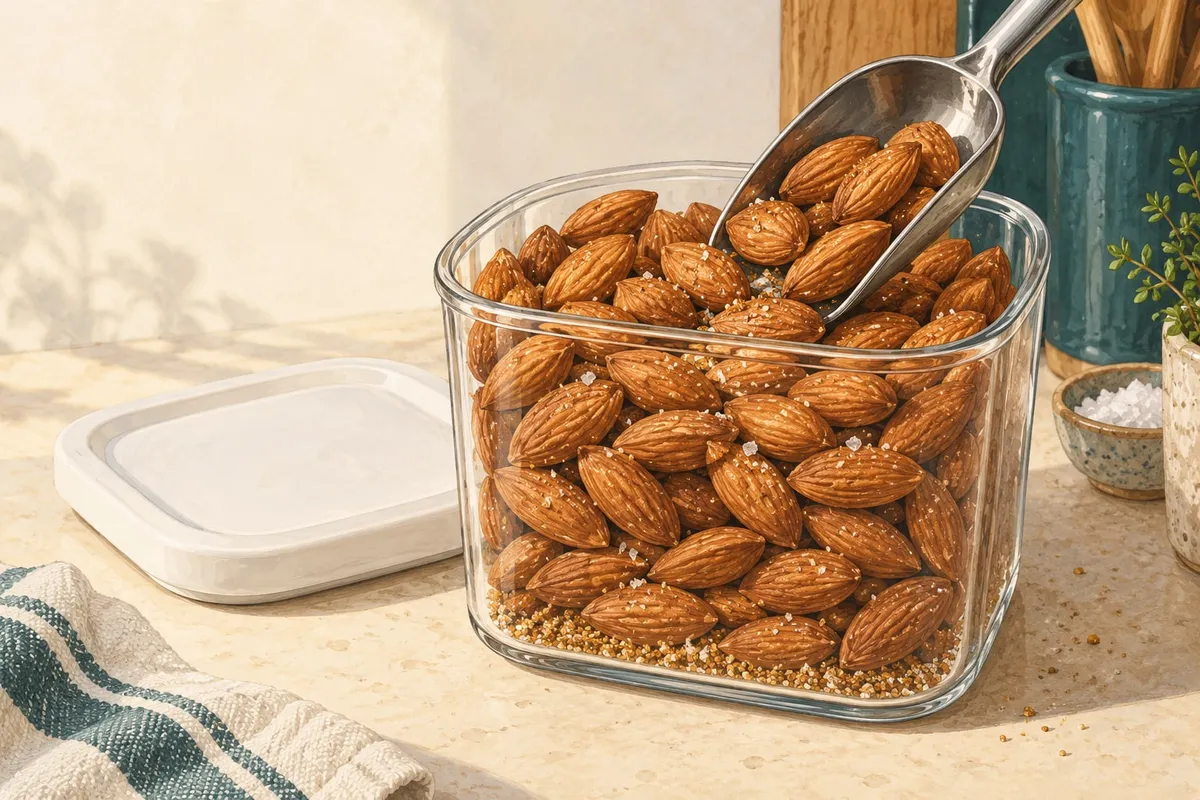
The hero image above is an AI-generated editorial illustration. The experiment photographs below are the real ones.
My daughter asked me what contamination means. Around the same time, my wife accidentally arranged a practical demonstration in the bulk-food aisle.
She bought smoked almonds and salted almonds, mixed them in a bag, and later transferred them into a clear container similar to the one from my peanut M&M experiment. I did not know about the smoked part. I reached in expecting a salted almond and discovered that my snack had apparently spent the afternoon near a barbecue.
This raised two questions. First: what, exactly, had I eaten? Second: could I rescue the plain ones with a spoon?
The smoked almonds had been at the bottom of the bag. After the transfer, they were on top of the container. That seemed promising. The unwanted part of lunch had helpfully presented itself for extraction.
I acquired a scoop and promoted myself to Director of Almond Remediation.
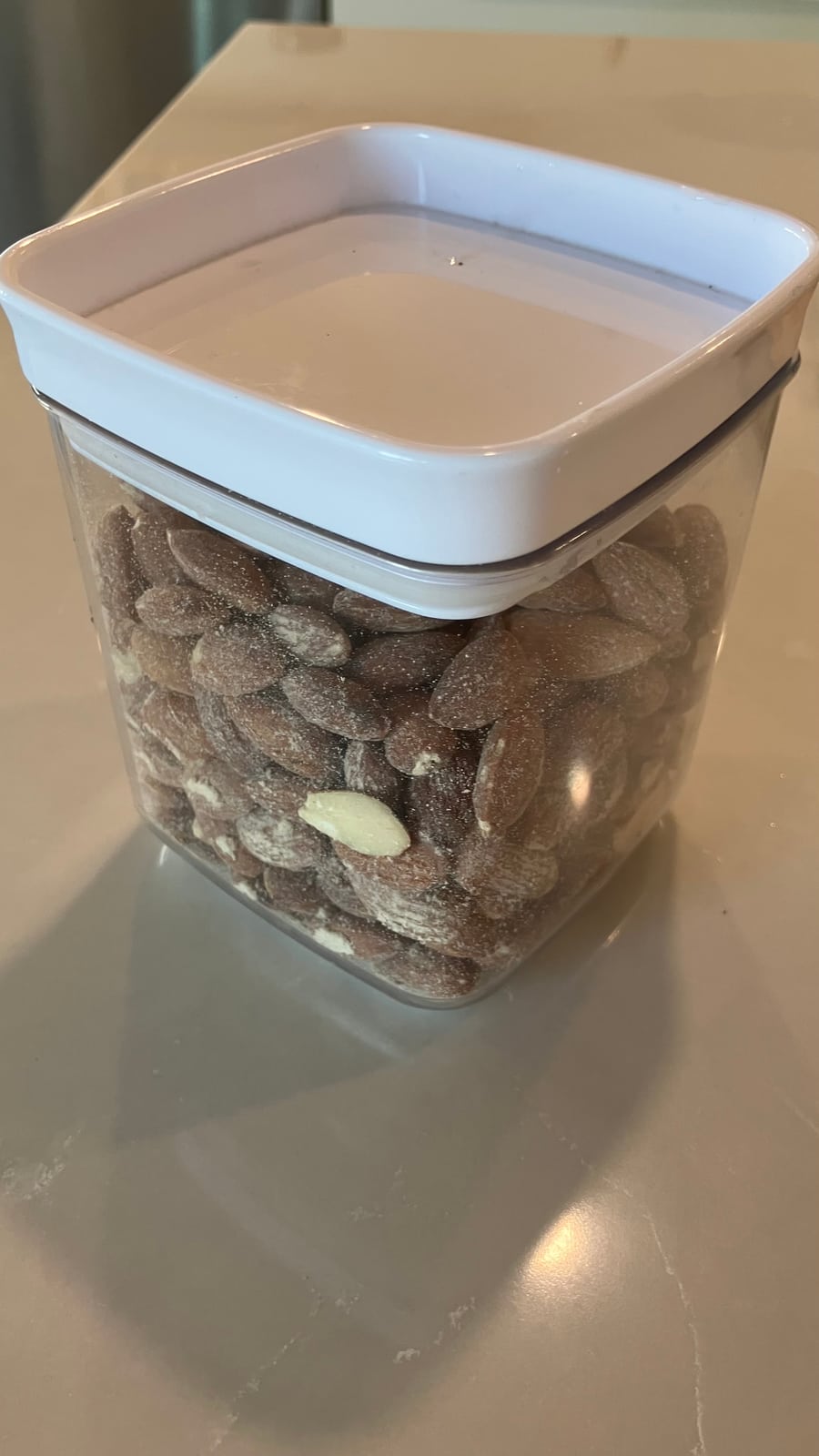
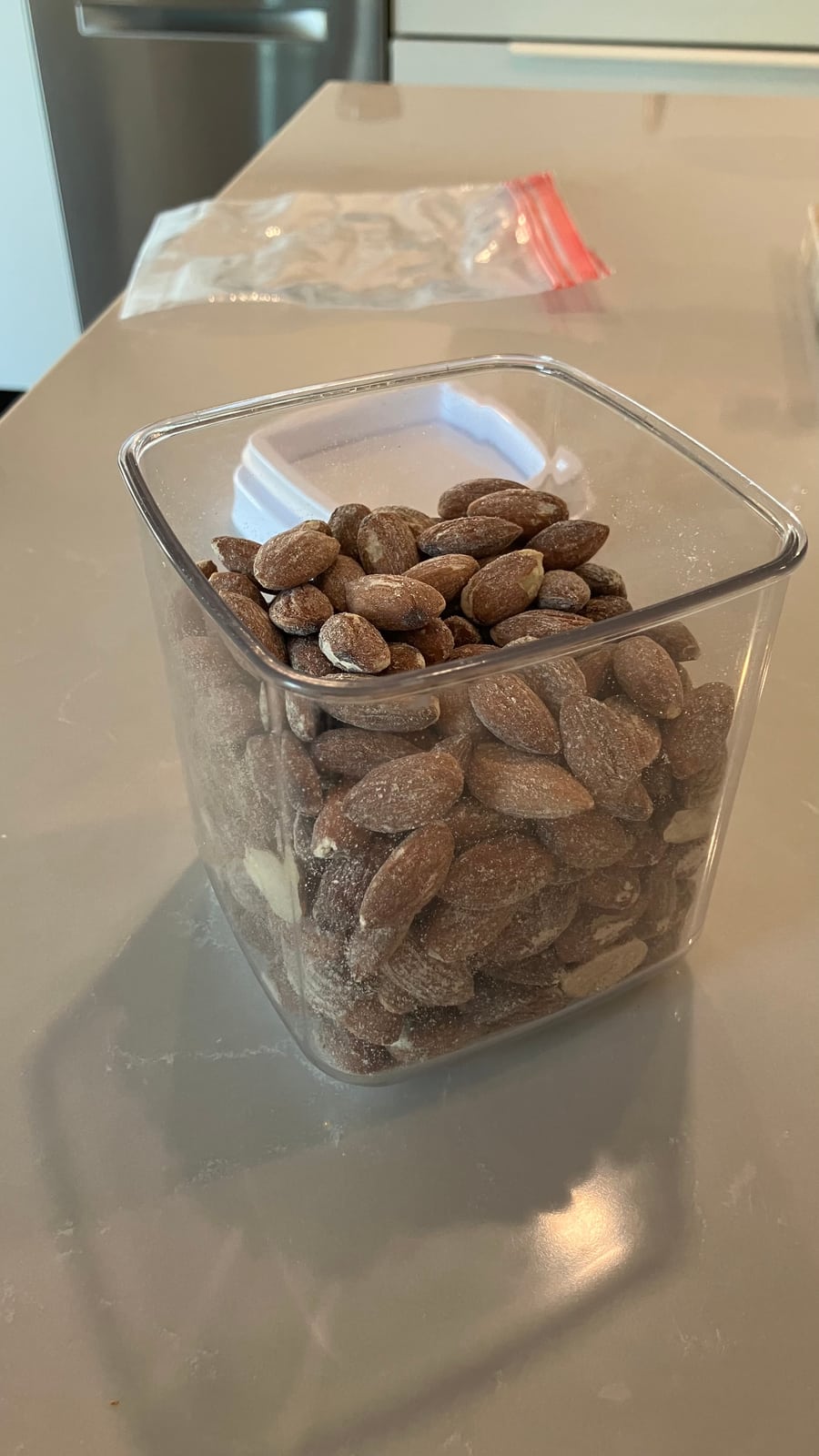
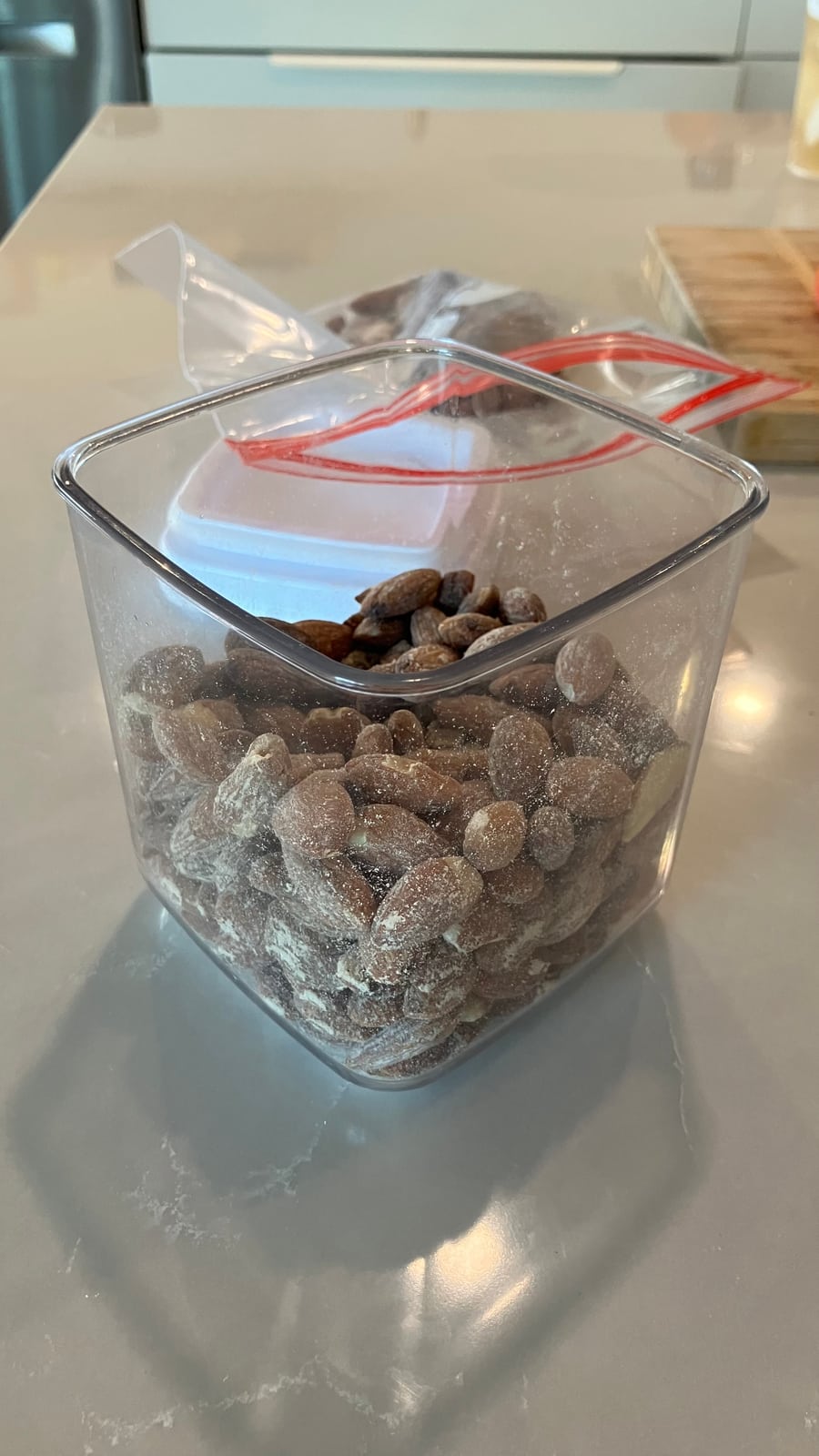
The photographs show almonds and powdery residue, but appearance alone does not reliably identify which almonds are smoked.
A definition you can eat around
For my daughter, I would explain contamination this way: something gets into something else where you did not want it, and changes it. It might be visible, or it might be too small to see.
Here, “contamination” means unwanted flavor or seasoning in the snack I expected. It is not a finding that the almonds are unsafe. My wife had made a deliberate mixture. I had made an incorrect assumption about its contents. The incident involved a failure of snack intelligence.
There is another distinction. My surprising first bite could simply have been a smoked almond. It does not prove that an originally salted almond had picked up smoky flavor. To establish that, we would need to identify the originally plain almonds and check them separately.
Still, scooping out the obvious candidates raises a useful scientific question: are you removing everything that came with them?
The almonds are only the large pieces
In the M&M experiment, the two things I wanted to mix were both whole candies. Here, there are at least two different scales of object: large almonds and much smaller loose grains or fragments.
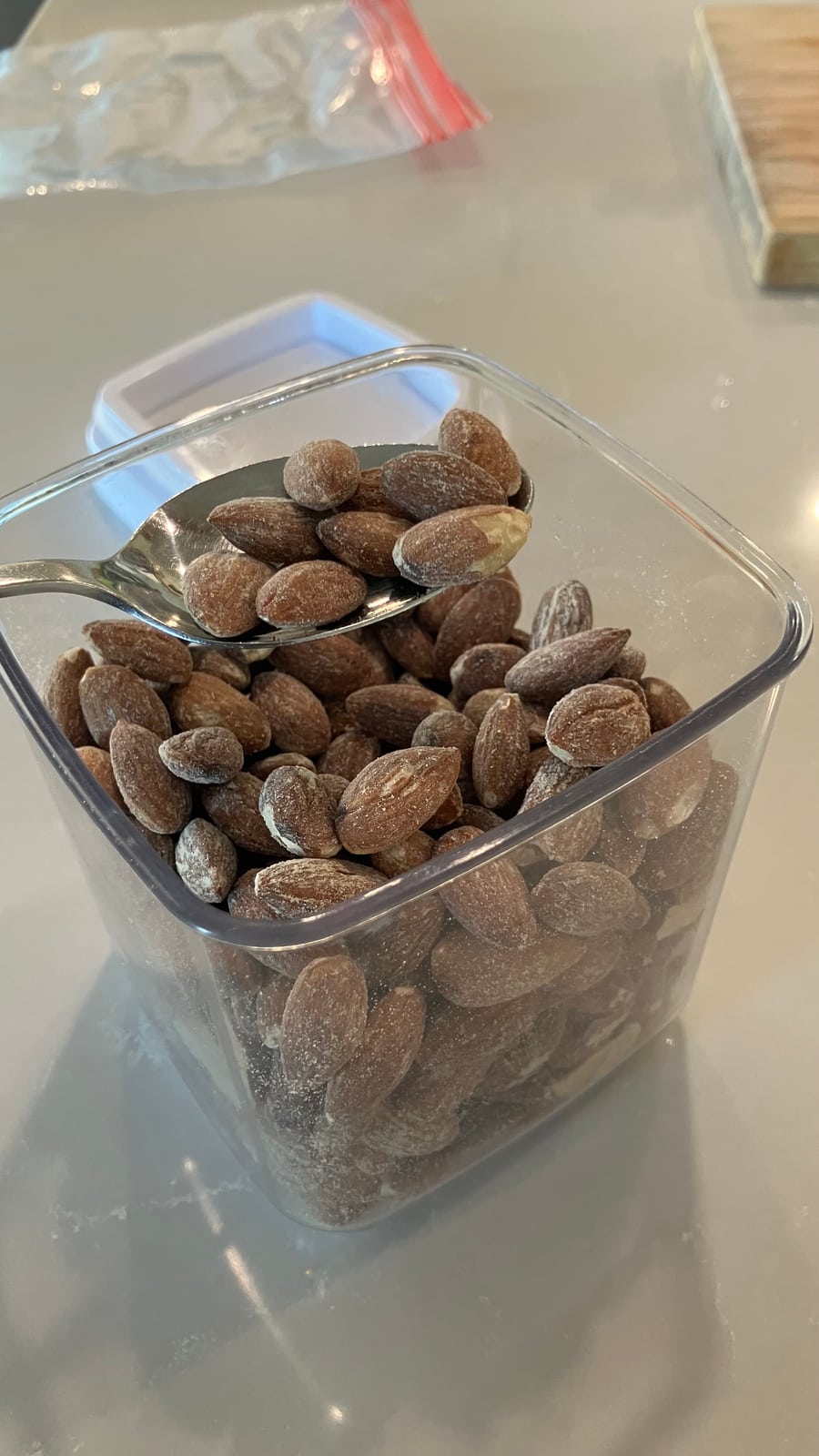
The photographs show pale material on almond surfaces and the container walls, with residue visible near the base. I also noticed seasoning settling toward the bottom. The images document where material is visible; they do not identify its ingredients or measure how fast it moved.
Some of that material may be salt. Some may be other seasoning or almond fragments. A photograph cannot provide a chemical inventory, however confidently I stare at it.
Removing large objects and removing fine residue are different jobs.
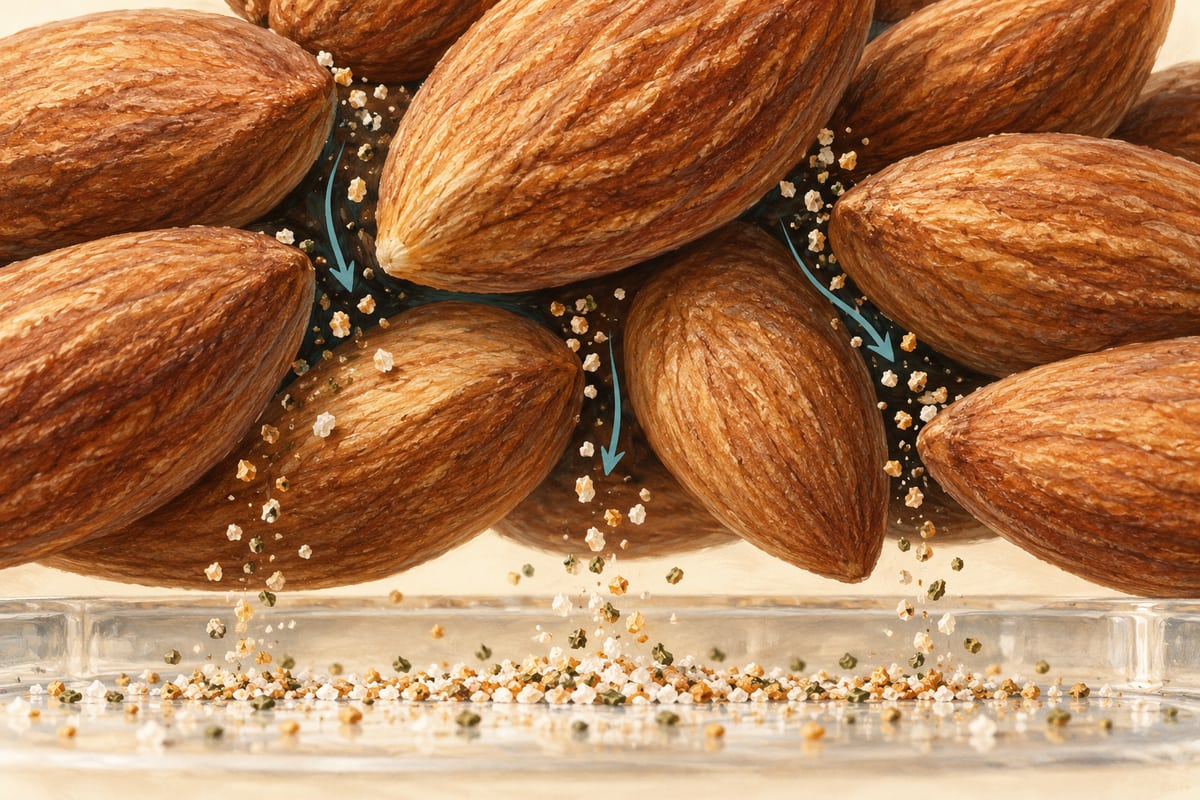
The gaps between almonds give loose particles another way through the container. A small grain may fit through an opening that an almond cannot. As a granular pile moves and rearranges, this can contribute to smaller particles moving downward. Researchers study this under particle-size segregation, including a mechanism called kinetic sieving. It is one possible explanation for the residue pattern, not a diagnosis established by these four photos. [1]
The practical consequence is wonderfully inconvenient: the smoked almonds could be near the top while some loose material associated with the mixture is farther down.
My scoop has jurisdiction over the top of the pile. It does not have subpoena power over every grain.
Did the bag turn the experiment upside down?
The reported change from bottom-of-bag to top-of-container also deserves caution. Transferring a bag can change the order in which material enters a container. The way it is tipped, emptied, and rearranged matters.
That reversal alone is not evidence of the Brazil nut effect. We did not film the pour or track individual almonds. Sometimes a complicated-looking rearrangement begins with the very ordinary act of turning a bag over.
The small grains are a separate problem. Their movement need not follow the almonds that originally carried or accompanied them.
A computer model with appropriately modest ambitions
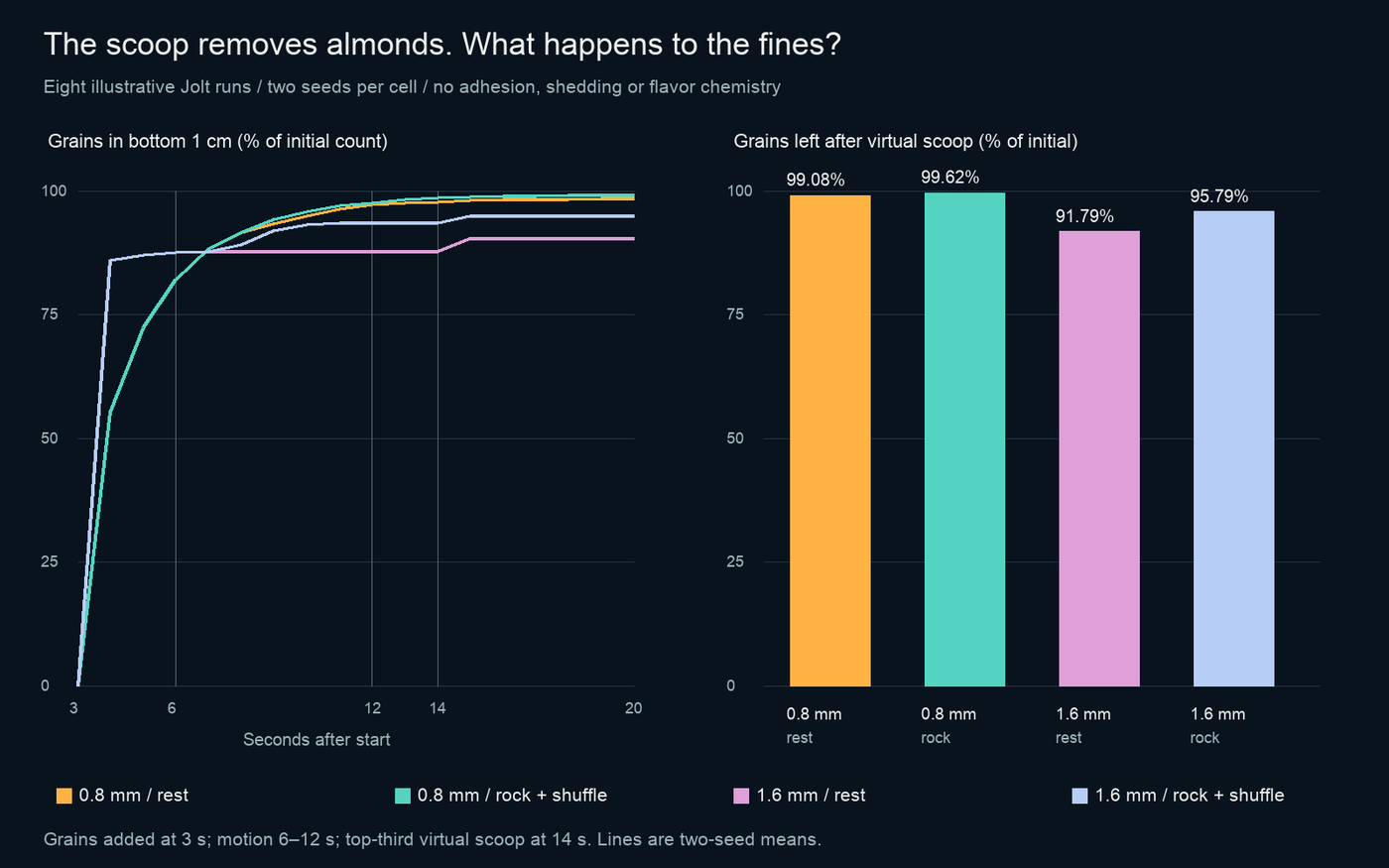
To explore that difference, I built a companion Godot example: almond-shaped bodies, much smaller loose grains, gravity, gentle rocking, and a virtual scoop. The model asks where the grains go and how many remain after the upper third of the almonds is removed.
The fine particles are deliberately coarse stand-ins for loose seasoning, not simulated flavor molecules. White and gold distinguish two tracer groups with identical physical settings. Their colors are labels, not claims about what is in the photographed powder.
Crucially, the model releases grains above a prepared almond pile. It does not simulate seasoning rubbing off an almond. It also leaves out particles sticking to oily surfaces, powder clumping, and flavor chemistry. Fine-particle adhesion can matter in real granular materials, which is one reason this remains “plausibly granular” rather than a calibrated reconstruction. [2]
In eight short runs, the virtual scoop removed 70 almonds each time. Depending on size and motion, the two-run averages left about 92–99.6% of the loose grains behind. Those are model outputs, not measurements of my snack. Taking out large pieces can leave small pieces behind; the model cannot tell us how smoky the remaining almonds taste.
The contamination lesson
A better physical experiment would start with known batches, a clean container, and a measured amount of loose seasoning. We could compare leaving it alone, gently moving it, and removing the top layer, then measure the residue that remains. I haven’t run that test yet, so this post doesn’t pretend otherwise.
For now, my daughter’s question has a useful answer. When something unwanted spreads into a mixture, removing the most obvious source may not remove everything it brought along.
This has critical implications for the solo astronaut on Mars whose snack inventory now contains an unplanned barbecue district. Before anyone proposes almond-based rocket stabilization, our current apparatus is a spoon.

Funding: self-funded, snacks.
Decontamination status: the large suspects can be questioned individually. The seasoning has dispersed.
Sources and image note
[1] J. M. N. T. Gray, “Particle Segregation in Dense Granular Flows” (2018), Annual Review of Fluid Mechanics.
[2] “Experimental models for cohesive granular materials: a review,” arXiv:2501.10830. Background on cohesive particles; not a study of these almonds.
Photos: my own, converted from HEIC to JPEG without retouching, then resized, with location and camera data removed before publishing. Statements about shopping, taste, layering, and observed settling are my own account. Photographs are not a controlled before-and-after flavor-transfer experiment. The three illustrations are AI-generated and labeled as such.